
Our quality improvement plan 2026 - 2027

Introduction from our Acting Chief Nurse, Julie Kirby
Every day our staff support people across Kent and Medway with serious mental health needs. It’s our responsibility to make sure they have safe, high-quality care and the kind of experience we'd want for our own friends and family.
Over the past year, feedback from patients and families, alongside independent reviews and regulatory inspections, has helped us better understand what we are doing well and where we need to do better. We have listened and acted.
Thanks to our dedicated staff, we have already made important progress, including addressing the issues behind the CQC warning notices put in place last year.
But we know there is more to do. Some people still wait too long for support, and people’s experiences of our services are not always as consistently good as they should be. We are determined to change that.
This Quality Improvement Plan sets out and monitors the practical actions that will improve care, strengthen safety and deliver better outcomes for patients. It builds on more than 200 improvements already made across our services over the past year and is an important part of delivering our Doing Well Together strategy.
We are publishing it because trust is built through actions, not words. We want patients, families, staff and our partners to be able to see the progress we are making. We will be open about what is working, where we still need to improve, and what we are doing about it.
This is our commitment to keep improving and provide safer, more accessible and consistently better care for everyone who relies on us.
How have we structured the quality improvement plan?
The Quality Improvement Plan brings together all improvement activity taking place across the trust, so everyone has one live and detailed action plan. It will continually evolve, as improvement never stops, and capture new regulatory findings, patient safety and patient experience learning.
Our work to improve quality is based around four key themes:
- safety and clinical risk
- access and waiting
- environment and experiences
- leadership and governance
This year we are working together, as one trust, on key priorities that sit under these 4 themes. So our people know where they need to focus in order drive proactive, meaningful and lasting improvements trust-wide. They are:
- improving clinical risk and care planning
- better administration of medicines and physical health checks
- embedding processes that support people whose needs are escalating
- improving caseload management
- better supporting people in crisis and neurodivergent people
- creating more therapeutic environments and more responsive services
- building our workforce’s capacity, skills and confidence
- improving our governance
- increasing our compliance with regulators’ standards.
Current plan status
- 60% delivered
- 29% on track
- 7% awaiting start
- 3% at risk
What are we focusing on this year?

Safety and clinical risk
We will provide safer care, reduce harm, strengthen clinical decision-making and improve patient outcomes.
Key areas of focus in year 1
- Making sure risks are identified clearly and consistently, and that everyone has a plan to stay safe so people receive the right support, at the right time; especially those in complex situations (such as crisis presentations and non-engagement).
- Improving care plans so they are personalised, up to date and capture the best available information, ensuring people are involved in decisions about their care and staff across all services have the information they need to provide safe, coordinated and effective support.
- Improving how we prescribe, review and monitor people who need medication for their mental health and regularly check their physical health to prevent problems and improve overall wellbeing.
- Embedding improvements to how we spot when someone’s needs or risks are increasing and responding quickly to keep them safe and help them get the support they need sooner.
- Learning from improved data, feedback and people’s experience as continuous learning helps us deliver safer, more effective care.
How will we know if we are being successful?
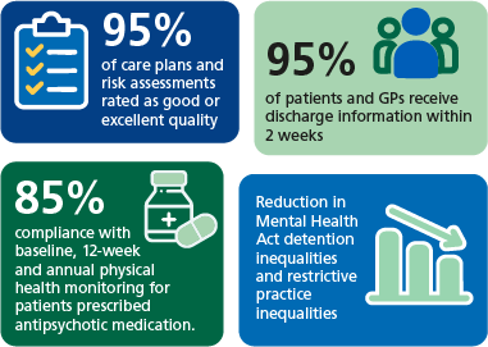
- 95% of care plans and risk assessments rated as good or excellent quality
- 95% of patients and GPs receive discharge information within 2 weeks
- 85% compliance with baseline, 12-week, and annual physical health monitoring for patients prescribed antipsychotic medication.
- Reduction in Mental Health Act detention inequalities and restrictive practice inequalities.
"I was listened to. I felt heard. I had a safe space I could talk to someone about what’s going on and work on a plan for moving forward."
Access and Waiting
We will provide faster access to our community services and better support for people while they wait.
Key areas of focus in Year 1
- Improving access to assessments, treatment and crisis support so people can get help when they need it, without unnecessary delays.
- Reducing waiting times and helping people stay safe while they wait so they receive support sooner, know how to look after themselves and where to go for help if their needs change.
- Improving how we manage caseloads, using better information and digital tools so our teams can identify people who need support most and respond to them more quickly.
- Improving outcomes for neurodivergent people by consistently discussing and recording autism, learning disability, communication needs and reasonable adjustments and equipping our staff to provide care that’s personalised to individual circumstances.
- Strengthening recovery focused care, reducing avoidable re-referrals and using feedback to improve patient experience, so more people achieve their goals, recover well and are less likely to need further support from our services.
How will we know we are being successful?
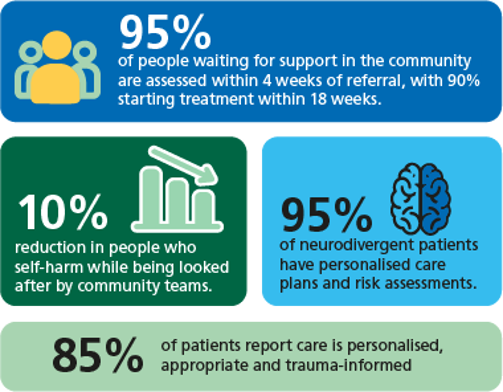
- 95% of people waiting for support in the community are assessed within 4 weeks of referral, with 90% starting treatment within 18 weeks.
- 10% reduction in people who self-harm while being looked after by community teams
- 95% of neurodivergent patients have personalised care plans and risk assessments
- 85% of patients report care is personalised, appropriate, and trauma-informed
"The process was prompt, compassionate, and well organised. I could not have asked for a better service, and am very grateful for the kindness, professionalism, and support I received during a difficult time."

Environment and experience
We will provide safer, more therapeutic environments and improve patient experience through better information and communication.
Key areas of focus in Year 1
- Creating more therapeutic and recovery focused wards and treatment spaces so people receive care in environments that protect their safety, are comfortable, welcoming and support recovery.
- Making information and services more accessible and inclusive so everyone can access, understand, and benefit from the support available.
- Enhancing patient experience by supporting our services to be more responsive and person-centred in the way they communicate with people.
- Increasing staff involvement in shaping and improving local environments as they are the people who best know our patients and their needs.
How will we know we are being successful?
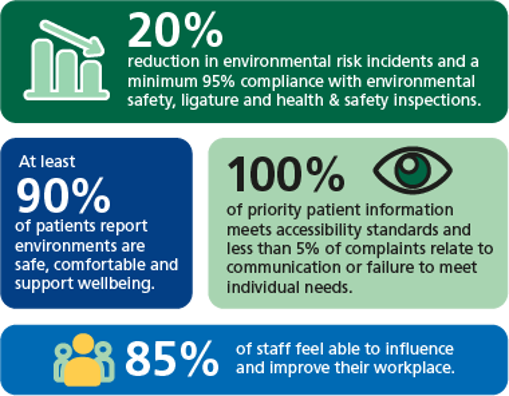
- 20% reduction in environmental risk incidents and a minimum 95% compliance with environmental safety, ligature and health & safety inspections.
- At least 90% of patients report environments are safe, comfortable and support wellbeing.
- 100% of priority patient information meets accessibility standards and less than 5% of complaints relate to communication or failure to meet individual needs.
- 60% of staff feel able to influence and improve their workplace.
"Everything was explained simply with lots of information to take home and digest in our own time"

Leadership and governance
We will ensure services are well led, well governed and supported by skilled staff who continuously learn and improve.
Key areas of focus in Year 1
- Continually providing staff with the training, skills and support they need to deliver high-quality, safe, effective and compassionate care.
- Strengthening oversight and making sure services meet national standards so patients and their loved ones can be confident in our care.
- Improving staff wellbeing, training and professional development so we retain a healthy, skilled workforce that delivers high-quality care and support.
- Being open, accountable and learning from feedback, complaints and safety concerns so people are listened to, concerns are addressed quickly and we continuously improve the quality of care.
- Increasing leadership visibility and oversight so risks are proactively identified and addressed quickly.
How will we know we are being successful?
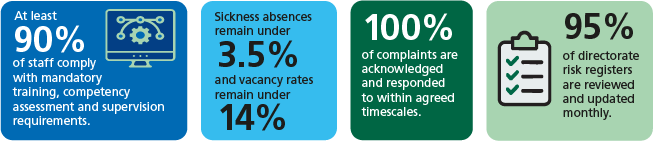
- At least 90% of staff comply with mandatory training, competency assessment and supervision requirements.
- Sickness absences remain under 3.5% and vacancy rates remain under 14%.
- 100% of complaints are acknowledged and responded to within agreed timescales.
- 95% of directorate risk registers are reviewed and updated monthly.
Successes so far
Over the past year, we have made more than 200 improvements across our services, and we are seeing important improvements as a result, including:
- 31% increase in the number of people with up-to-date risk assessments, helping staff identify and respond to concerns more quickly and consistently.
- Better safety planning and more consistent approaches to managing risk across our services.
- Halved the number of medical emergencies related to self-harm.
- Increase in the number of people with high quality care plans, giving staff better information about their needs, wishes and treatment.
- A significant increase in physical health checks, with nearly 79% of patients attending clozapine or depot clinics having the assessments needed to spot concerns.
- Care planning is more personalised, with stronger involvement from patients, carers and families in decisions about care and safety.
- Progressed work to better understand inequalities in Mental Health Act detentions and restrictive practice, enhanced community engagement and trained over 300 staff on protected characteristics and inequality.
Tell us what you think of our services
As part of this Quality Improvement Plan, we have changed how we measure success. Instead of focusing on whether actions have been completed, we now evaluate whether they are improving care and experiences for patients, carers and families.
To support this, we have introduced the Your Experience Matters survey for patients and their loved ones. This helps us understand whether our improvements are making the difference they need to and ensures patient and carer feedback shapes how we improve services. We are grateful to everyone who takes the time to share their experiences with us.
If you are a partner or member of our community not using services with ideas for improvement please email kmmh.headsofnursing@nhs.net


